Mobile app prototype vs MVP: what should you build first?
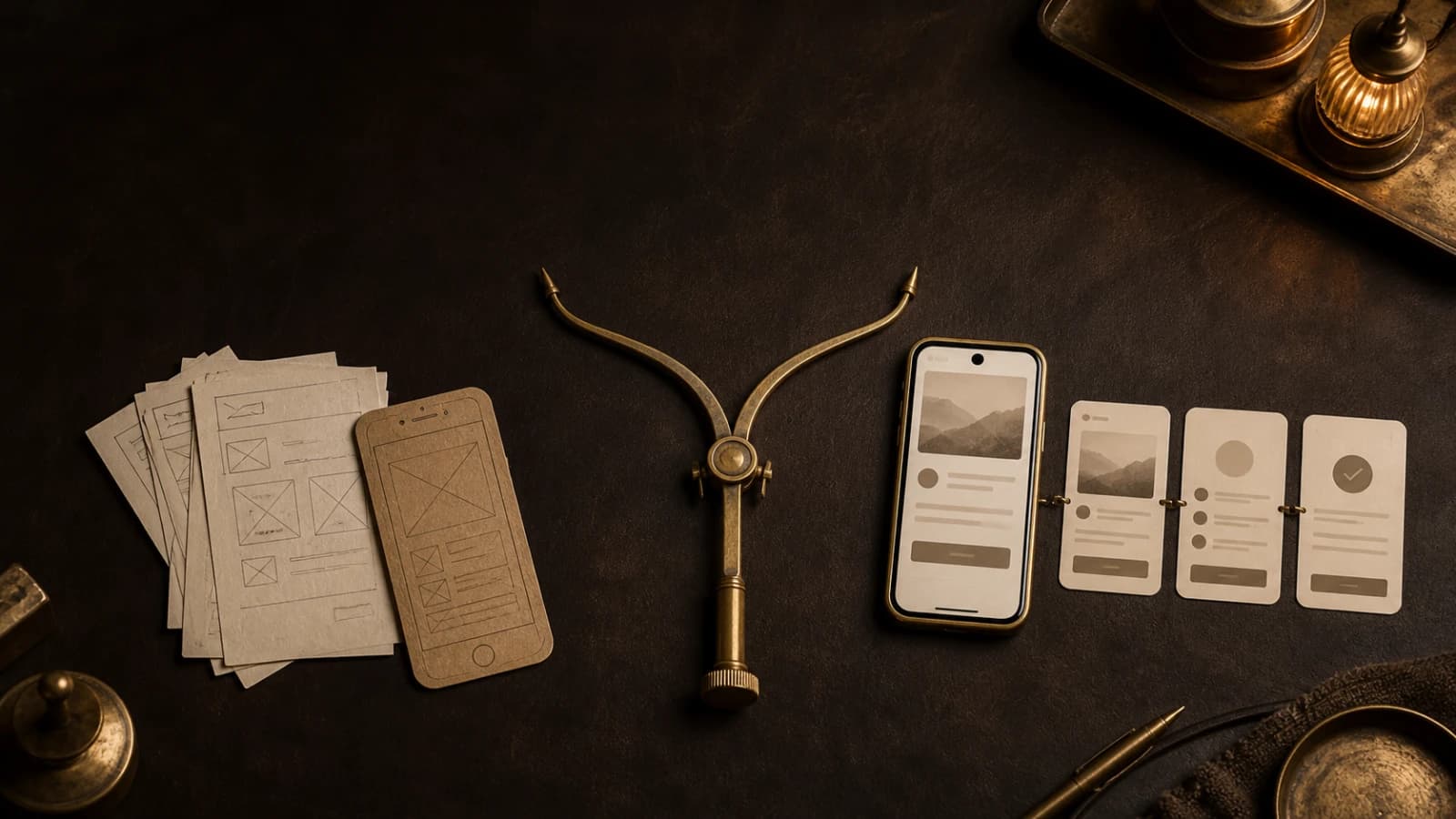
Doved Studio starts with the question that could invalidate your product. Build a prototype when you need to learn whether people understand the journey. Build a proof of concept when you need to prove risky technology. Build an MVP when you need to observe real, repeated use.
The right choice is not the deliverable that looks most impressive. It is the one that reduces your largest uncertainty now. A polished prototype does not prove that the app can handle real data. A working MVP does not rescue a problem nobody wants solved.
The short answer
| Deliverable | Main question | What you can simulate | Useful evidence |
|---|---|---|---|
| Prototype | Do people understand the journey? | Data, logic, payments, and integrations | Comprehension, errors, and hesitation |
| Proof of concept | Does the riskiest technology work? | Interface, operations, and the complete experience | Measured feasibility under realistic conditions |
| Manual pilot | Do people want the outcome? | Automation and administration | Real use, repetition, and outcome quality |
| MVP | Can a real product deliver the core value end to end? | Secondary features and nonessential automation | Journey completion, return use, and support needs |
Choose a prototype to test comprehension
A mobile prototype connects screens and simulates the main actions. It can show someone opening an assignment, completing a report, and confirming the result without storing any data. You can observe what people understand before you choose the architecture.
Give a representative person a specific task and ask them to think aloud. Watch where they stop. Do not explain the interface during the test. If you need to guide every step, the prototype has already taught you something useful.
Do not ask only whether someone likes the design. Ask them to complete a task. Their behavior gives you stronger evidence than a general opinion.
Choose a proof of concept to test feasibility
A proof of concept isolates one technical risk: offline sync, on-device recognition, Bluetooth, video capture, location, or an old API. It can look rough because its job is to measure a constraint, not sell the experience.
Define the success condition before testing. You might need to sync one hundred records without duplicates after a network loss, process video on the target devices, or retrieve usable data through an incomplete API. Without a threshold, a convincing demo can fail to reduce the risk.
Choose a manual pilot to test demand
You can sometimes deliver the result before automating the system. A person can prepare a recommendation, verify a booking, or turn a form into a report. Customers receive the outcome while your team learns which steps deserve automation.
Keep the pilot honest. Tell participants which work happens manually, and protect their data as carefully as you would in a live product. Do not present hidden human operations as software that already exists.
Choose an MVP to test real use
An MVP is a working product. A person can complete the primary journey with real data, retrieve the result, and get help when something fails. The product must handle loading, errors, denied permissions, empty data, and recovery.
Before release, review Apple’s App Review Guidelines and the Android core app quality guidelines. An MVP reduces features. It does not reduce your privacy, security, accessibility, or support duties.
You do not always follow prototype, then MVP
If an API creates the largest risk, start with a technical proof. If demand remains uncertain, begin with structured research or a manual pilot. If you already run the service manually and understand the journey, a focused MVP may be the logical next step.
You can also run two tests in parallel. Validate the journey with a prototype while an engineer tests the risky integration in a separate proof of concept. Combine the evidence before funding the MVP.
Ask five questions before construction
- Which assumption could still make the product unnecessary?
- What observable evidence would reduce that uncertainty?
- Which deliverable produces that evidence with the least construction?
- Which people, data, and realistic conditions does the test require?
- What will you decide if the test succeeds or fails?
The best first deliverable is not the most complete. It is the one that lets you make the next decision with evidence.